Thursday, 18 July 2013

Denso-Marston Nature Reserve, Baildon - Sunday 14th July

A big thank you to everyone who came to our event at Denso-Marston Nature Reserve on Sunday 14th July. We had a great turnout and great weather!

Opening the moth traps

Reserve warden Steve Warrillow made us very welcome, as always. First, Steve suggested we open the moth traps. It's always exciting, because you never know what you might find! The most abundant moth we found was the Poplar Hawk-moth, just as it was at our last event at Rodley Nature Reserve.
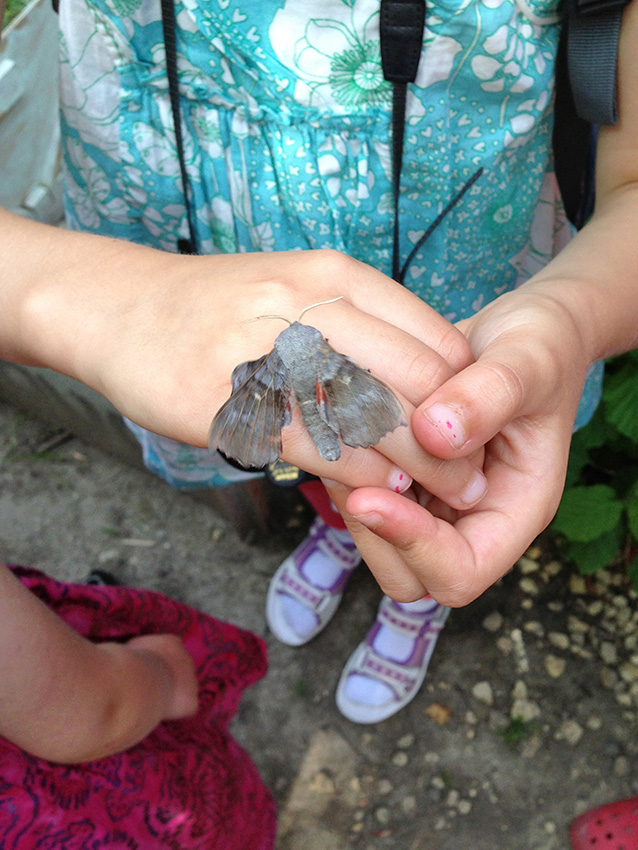
Poplar Hawk-moth

There were plenty of moths in the traps, and the two most beautiful were probably the Buff Arches and the Burnished Bronze.

Burnished Brass moth

Next up was... Bug hunting! We were kitted out with large butterfly nets and sent around the reserve to catch anything that moved (or didn't move, for that matter). We found several Harlequin Ladybirds, including their tiny larva. The larval stage of a insect in the stage between the eggs and the full grown adults, such as caterpillars (butterflies and moths), maggots (flies), and those scary-looking creatures in ponds that become dragonflies.
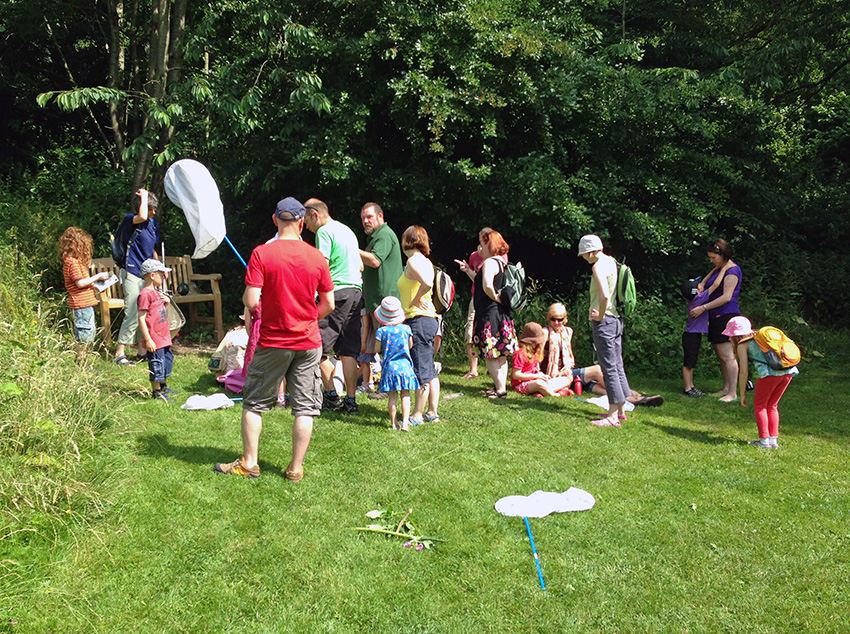
Bug hunting

We found the larva of the Peacock butterfly, which feed on nettles. These are striking black caterpillars with spangly silver stars on them.

Peacock butterfly larva

We also caught some Ringlets (small dark butterflies with pretty ring shapes on their wings), soldier beetles, and all kinds of other tiny bugs.

As we walked around the reserve Steve explained to us about Himalayan Balsam, a plant introduced into the Britain which doesn't really belong here. It grows here so well that it takes all the space a light, making it difficult for other plants to grow. They have attractive flowers, but many nature reserves have to remove them to help our native plants.

Steve explains why we have to remove Himalayan Balsam

Finally we did some brilliant pond dipping. Amongst the many creatures we found were water boatmen, diving beetles, damselfly larvae, leeches, tadpoles, froglets, and tiny young smooth newts. The young newts have feathery plumes at the side of their heads. These are their gills, which will be replaced by internal lungs (like ours) when they become adults.


 Pond dipping

All the while a young Moorhen called out from the pond, and a fantastic Brown Hawker (a type of large dragonfly) zoomed around over our heads. Cam found the skin of a Brown Hawker nymph, possibly from the very dragonfly we could see flying around. This skin cast (called an exuvia) is the skin of the dragonfly while it's underwater in its larval (or nymph) stage. The dragonfly nymph crawls out of the water a pushes itself out of the old skin and pumps up its wings to become a fully adult dragonfly.

The skin of a Brown Hawker nymph

Thanks again to all the children and parents who came along. The Airedale Otters now have their annual break for the summer holidays. Our next event is a Bat Walk at St Ives, Bingley, on Saturday 14th September.

In the meantime we hope you all have a great summer holiday, and hopefully find lots of interesting wildlife on your travels or closer to home. Please bring any interesting stories or items you've found to our next event. Why not keep a nature scrapbook, recording any the interesting wildlife you see? Here's one we've started at Airedale Otters HQ:
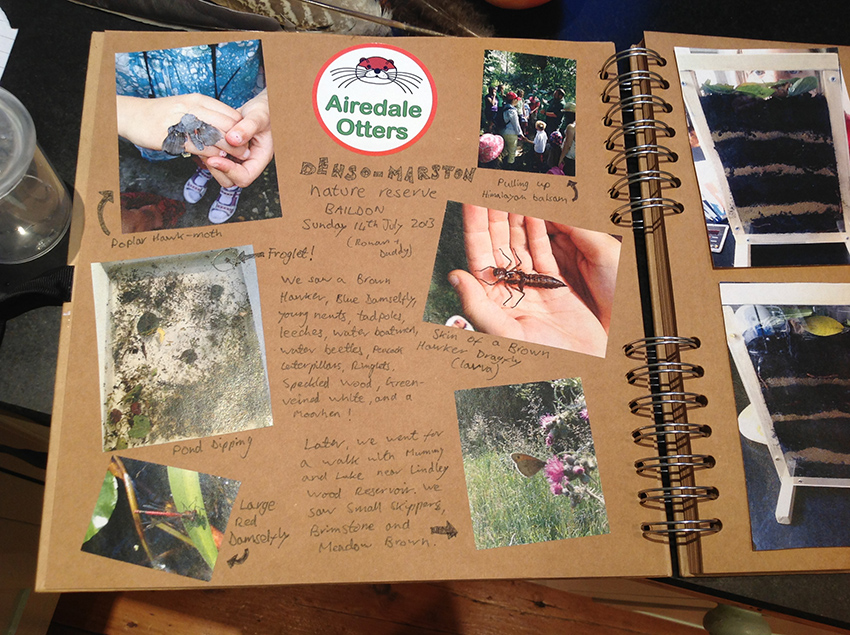
Why not keep a nature scrapbook like this one?

Wednesday, 5 June 2013

Springwatch Day at Rodley Nature Reserve - Saturday 8th June

Thanks to everyone who came to the  Springwatch event at Rodley Nature Reserve with the Airedale Otters. It was an early start - 8:30 am - but worth it. We couldn't have asked for better weather, or better wildlife - we had moths, mammals, birds, butterflies, dragonflies, newts, and all kinds of mini beats from the pond!

The first event of the day was to open the moth traps. Peter Murphy from Rodley Nature Reserve helped us put names to the each moth as it was taken from the trap. The trap doesn't hurt the moths, it simply uses a bright light to attract them, after which the moths settle down for a rest on the egg boxes placed inside.

Opening the moth trap

One of the first moths out was a fantastic Elephant Hawk-moth! Pink and green - wow! The "Elephant" part of the name comes from the when the insect is still a caterpillar, because it has a trunk-like section just behind its head. The biggest moth we found was the Poplar Hawk-moth - there were three of these in the trap. One of the most striking moths was the White Ermine, which did indeed look as if it was made of a stoat's winter fur (used to trim royal gowns).

Here are just some of the moths we saw:

Elephant Hawk-moth

Poplar Hawk-moth

Common Swift Moth

Silver Ground Carpet Moth

Small Magpie Moth

White Ermine Moth

Buff Tip Moth

Next, mammal experts John and Maxine took around the reserve to open the mammal traps they had set the night before. Most of the traps contained either a Bank Vole or a Wood Mouse (sometimes called a Long-tailed Field Mouse). It was a great opportunity to see the differences between these two mammals: the Bank Vole is large with grey-brown fur, whereas the Wood Mouse is smaller but has bigger eyes and ears and a longer tail, with more chestnut-brown fur.

 Opening the mammal traps

Bank Vole

 Wood Mouse

Wood Mouse

Another Wood Mouse

The group then split up as more events happened around the reserve and people went to have picnics. We had a great time at the pond-dipping pool, fishing out tadpoles, caddisfly and damselfly larvae, water boatmen, diving beetles, and small fish.

Pond dipping

While eating our picnic, we watched a pair of Common Whitethroat (a small songbird, part of the warbler family) flying to and fro across the dragonfly pools. They were bringing food to their chicks in a nest hidden in the long grass by a pond.

Small Tortoiseshell Butterfly

In one of the dragonfly conservation ponds we spent a fascinating half hour watching newts. We were allowed to get one out with a net to have a closer look at it and we were able to identify it as a smooth newt, which is the commonest UK newt.

 Smooth Newt

Whilst watching the newts, we spotted something large and pale, writhing around in the pond; on closer inspection, we discovered that this was a luckless dragonfly larvae, being devoured by a newt (rather larger than the newt in the photo).  The head of the dragonfly larvae was in the newt's mouth but it put up a good fight as dragonfly larvae can be quite aggressive themselves and even eat small fish! But then two more newts came along to join in the feast and, from that point on, the dragonfly larvae didn't really stand a chance!  Being a dragonfly is obviously a risky business - we also saw this dragonfly with only three wings, which had probably had a run in with a hungry bird.

 Broad-bodied Chaser (female)

Cardinal Beetle

A fantastic day out thanks again to everyone who attended, and a big thanks to the staff and volunteers at Rodley Nature Reserve.

Thursday, 14 March 2013

Otter Walk, Bingley - Saturday 9th March

It was cold, wet and the forecast was for snow. The weather prompted a late change of meeting point, so we met in the Bingley Market car park close to the river and Myrtle Park. Our aim was a tall order - to find evidence of an elusive, nocturnal animal – our namesake the Otter!

Throstle's Nest stone - River Aire, Bingley

We descended the steps to Throstle’s nest and started to scan for exposed boulders in and at the edge of the river. Otters scent-mark their territory with spraint (poo!) in much the same way as other mammals like cats and foxes do. This might warn travelling otters that there is a resident on that stretch, either to attract a potential mate, or warn off competition.  It may also serve as a “calling card” for otters moving through an area to advertise their presence.

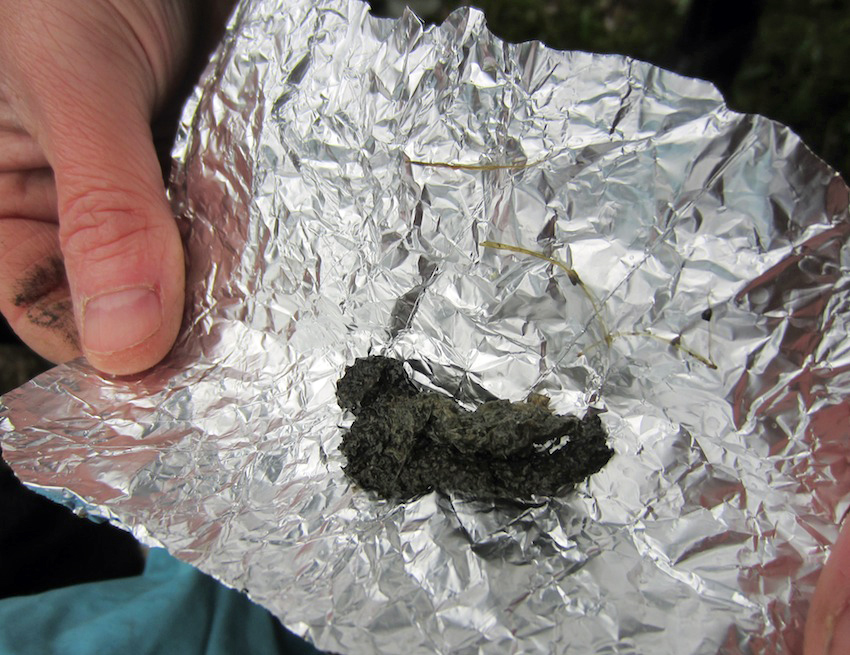
The spraint is thought to inform otters about age, sex, health and diet of the marking animal. It is black, 3 to 10 cm and flecked with bones and scales from the otter’s lunch!

Our first bird sighting was a grey wagtail, then another.  Next was a Wren (whose scientific name is Troglodytes troglodytes, which means "cave dweller" in Latin), scouting around the under-cut river bank. A short distance on, and only a stone’s throw from the town centre, we found some Otter spraint on a boulder in the water.

Cam prepares to get the spraint from the boulder

The Otter spraint - you can see the fish bones we found in it on the foil

The only way to experience the distinctive scent of an Otter spraint is to give it a sniff!

We found more 50m on and then crossed the river to check a sand bar for prints.  No otter, but a smaller 5-fingered print, probably a mink.  We also saw a single Fallow deer print (did it hop?!).

Mink tracks - Myrtle Park, Bingley

Our walk then took us up into Mouse Wood above the river, heralded by two woodpeckers, calling from the tree tops and startling a colourful Jay.  A deviation up Harden Beck revealed more otter sign, though Cam nearly had an ‘early bath’ collecting it.  So we know they travel up the smaller water courses feeding the river Aire.

Apart from a flock of Siskins high in the birch trees and a quick team photo on the Beckfoot Bridge, that was our lot.  We were all surprised at how much evidence of our otters we had found. Otter has made an incredible recovery from hunting, pollution and habitat loss and I have looked forward to their return since I was a child, so this was a warming event, on a cold day!

The Airdeale Otters at the end of a successful Otter spraint search!

Thank you to everyone who braved the weather and we hope you enjoyed it as much as we did.

Monday, 21 January 2013

RSPB Big Garden Birdwatch at St Ives, Bingley - Sunday 27th January


Thanks to everyone who turned up on Sunday 27th January to help out with the Big Garden Birdwatch survey. It is a really important survey, which helps the RSPB understand how well the birds are doing and gives us a ‘snapshot’ of bird numbers across the UK.


 Team talk

The snow had completely disappeared by the time we arrived at St Ives on Sunday morning but it was still a bitterly cold morning in the bird hide! But the excitement of seeing lots of different birds landing on the feeders and on the ground was enough to help take the hardy Otters’ minds off the cold.  The Otters leaders had been out on the Saturday and earlier on Sunday morning, putting out lots of tempting treats on the feeders and the ground for the birds. The birds could choose from peanuts, a variety of seeds, meal worm, fat balls and some of the feeders made at the Otters Christmas event – a real feast!  

And it was worth it. It is difficult to say precisely how many birds we saw because you have to try not to count the same bird over and over again but, in the hour we were there, we saw 14 different species, for a total of about 32 birds. The Otters all came armed with notebooks, pencils, bird identification books and binoculars to help us to be as accurate as possible.

The Nutchatches were the first to take advantage of all the food on offer and many of the Otters will now be expert at recognising this plump little bird with blue-grey feathers on its back, orange breast, and long black pointed bill, as at least four of them were constantly flying in and out to the feeders the whole time we were there. We saw three species of tit  – the smaller greyish Coal Tit, recognisable by the way it flits in, snatches a seed and flies out again, the larger Great Tit, with its distinctive glossy black head, and the familiar Blue Tit with its colourful mix of blue, yellow, white and green. 


 Nuthatch (photo Stephen Lilley)

The stars of the show, however, were the beautiful Jays. We recorded three of these striking birds, the most colourful members of the crow family. Normally they are quite difficult to see and it is usually their screaming call, which lets you know there is one about. But on Sunday, they put on a real show for us, as they couldn’t get enough of the peanuts that had been scattered all over the ground for their enjoyment! 


Jay (photo Stephen Lilley)

We saw five Blackbirds – including males and females and all the Otters should now be able to explain the difference! Right at the end of the hour, Nick spotted a Treecreeper and no prizes for guessing what it was doing – yes you’ve got it – it was creeping up a tree, looking for insects. This behaviour and its long curved bill make the Treecreeper easy to recognise once you’ve spotted it!


The list of birds

Other visitors to the hide area that morning were Robins, Chaffinch, Magpie, Dunnock, Wren and Song Thrush. The full list of birds recorded by the Airedale Otters is below - click on a link to learn more about the bird:
The total of 14 species was not as high as the number of species we identified in our bird race last spring, as it was too early in the year for the summer visitors.  But all in all, a good day’s work for a cold January day, so well done Otters! The RSPB will publish the Big Garden Birdwatch results later in the year.

Tuesday, 27 November 2012

Christmas Event, St Ives, Bingley - Sunday 2nd December


Thank you to everyone who came to the Airedale Otters Christmas event at St Ives and made it such fun occasion.

The weather was great - it was a beautiful bright, sunny day, but quite chilly. We started with a walk around Coppice Pond and a visit to the bird feeders. It was a quiet morning for wildlife, so we soon headed back to the warmth of the St Ives visitor centre with its lovely roaring fire. The rooms were beautifully prepared for us by the Friends of St Ives - many thanks to them. So many Otters turned up it was a tight squeeze!

We had hot dogs cooked on the range, and mince pies, buns and juice. The mulled wine for the grown-ups went very quickly!

Everyone had the chance to make felt bird decorations of Robin, Blue Tit, Coal Tit, Chaffinch, Goldfinch, or House Sparrow – and to learn to identify these birds as we made them.


A Goldfinch and Blue Tit hanging from our Christmas tree!
 
This year’s bird song quiz was about the more unusual, weird and funny noises some British birds make.  We heard the Booming Bittern, the yaffling Green Woodpecker, the screaming Swift, and the churring Nightjar – not to forget the Corncrake, which rhymes with corn flake! We also learnt that some birds say their name: Cuckoo, Chiffchaff, and Jackdaw.

Click on the name of a bird above to learn more about the bird and listen to its song again. The quiz prize was a bird feeder and bird ID book, which the winners donated to their local school. Well done!

Finally, Cam got his hands dirty and mushed up a big pile of lard, mealworms and seeds to make some bird feeders. Here are two we made, hanging in an Otter’s garden. 


By feeding the birds in your garden you’ll be helping them survive periods of severe winter weather. This will help them be in the best condition at the start of the breeding season in the spring. Let us know what birds you seen on your feeders this winter.

Thanks again to everyone who came and made it such fun event. We will soon be posting a full list of events for 2013 - along with details of our next event, which coincides with the RSPB Big Garden Birdwatch on the weekend of 26/27th January.

The leaders of the Airedale Otters would like to thank all our members and parents for their continued attendance this year. We hope to see you all again in January.

Have a fantastic Christmas and a Happy New Year!

Monday, 12 November 2012

Checking Nest Boxes at Deep Cliff Wood, Harden - Sunday 18th November

Thank you to everyone who came to the fascinating and fun event at Deep Cliff Wood in Harden on Sunday 18th November. We cleaned out the nest boxes we made in January, getting them ready for next Spring.


 Deep Cliff Wood, Sunday 18th November

It was always a mystery when cleaning out nest boxes – who knows what you might find?! Well, out of the 14 next boxes, at least ten of them had been used. 


 Checking the first nest box

Nest boxes 1 and 5 contained only bird poo, which suggests that birds have been using them at night to roost.  Smaller birds, such as Blue Tits and Wrens, often use nest boxes to sleep in during winter nights (up to 60 Wrens were recorded in a nest box once!).

There were two half–built nests, in nest boxes 4 and DJM. Birds stop building nests for several reasons: maybe one of the parents were injured or killed (possibly by a predator like a Sparrowhawk), or maybe they were struggling in the bad weather. If, the birds were struggling to find food or keep themselves warm in all the rain, they may have decided to stop and try again later when the weather improved. Building a nest, laying eggs, and then raising a family is very hard work for a small bird. They will only carry on if they have a realistic chance of raising at least one chick.


 Blue Tit nest from nest box 3


 Blue Tit nest from nest box 12

In nest boxes 3, 10, and 12 we found complete Blue Tit nests. It is likely the birds in these nest boxes successfully raised families!


Checking nest box 6

It was a mixed story for nest boxes 6 and 23. Both had Blue Tit nests, with two eggs in Number 6 and three in Number 23. Hopefully, these Blue Tit families successfully raised chicks from other eggs, but like the half-built nests we found, these nests may have been abandoned before the mother had finished laying all her eggs.


Blue Tit nest from nest box 6


Blue Tit nest from nest box 23

Nest boxes 2, 8, 9, and 11 were all empty and clean. Hopefully these will be used next year.

Here’s a full list of the nest boxes:

Box number
What we found
1
Bird poo!
2
Empty and clean
3
Complete Blue Tit nest (no eggs found)
4
Partially-built nest
5
Bird poo!
6
Blue Tit nest with two eggs
7
Partially-built Blue Tit nest. Box chewed by squirrel
8
Empty and clean
9
Empty and clean
10
Successful nest
11
Empty and clean
12
Blue Tit nest and bird poo
23
Blue Tit nest with three eggs (one hatched)
DJM
Partially-built nest

We also brought some old birds’ nests we had collected, so we could have a closer look at how nests are made and how to tell the nest of one species from another. And there’s no better way of telling how a nest is made than pulling them apart!


 Looking at an old Great Tit nest

The three Blackbird nests were all made of a mud cup, lined inside and out with grass. The Song Thrush nest was similar, but with more twigs and leaves. The larger Woodpigeon nest was made of small sticks woven together. It looked quite flimsy, but was in fact quite strong. 

The Great Tit nest was similar to the Blue Tit nests we found in the boxes: a soft cup of moss, grass, feathers and bits of other things like string. We had one other nest, again similar to the Blue and Great Tit nests, but this time covered over with roof! It had a small hole in the top for the birds to come in and out. This nest was found in roof, under the eaves, so it was probably made by a House Sparrow.

We also had a brilliant game of Wildlife Bingo. I thought the Otters might struggle to find some of the things on the bingo cards, but almost everyone found everything! Well done!

While looking around we found a Common Earthball fungus, which often grows near birch and oak and there are plenty of those in Deep Cliff Wood.


Common Earthball in Deep Cliff Wood

Another lovely day in out in our wood, and the weather stayed mostly sunny too.

Tuesday, 9 October 2012

Bat Walk at St Ives, Bingley - Saturday 8th September

We had a great evening walk around St Ives estate looking – and listening – for bats.

We met at 7pm and joined up with the Friends of St Ives group, squeezing into the new visitor centre. Bat expert Ian Butterfield told us some amazing bat facts and explained how bats can be identified by their calls, and how we can tell what they are doing by the sounds they make. The bats calls are so high-pitched that people can’t normally hear them. The best way to find bats is with a bat detector, which converts the bats’ calls into sounds that people can hear. So Ian told us what to look and listen out for, and we all piled outside to go looking for bats.

The weather was perfect – the sun had been shining for most of the day and that meant we had a warm and still evening. First, we went searching along the tree-lined paths behind the golf course (see the map of St Ives here). It wasn’t until reached White Cote Barn that our bat detectors started to crackle.  Somewhere above was a bat… Then out of the blue, we saw our first bat – a Pipistelle! At least two of these small bats flew right over our heads along the path. We really needed the bat detectors to keep track of them – they’re so fast – and even then we could hardly keep track.

We walked down towards Coppice Pond, finding more Pipistelles on the way. It was quite dark by now, but not too dark for one Airedale Otter to find this spider running across the road almost under our feet. Someone’s been eating all their carrots!

Spider, St Ives, Bingley - 8th September 2012

It didn’t take long to find more bats hunting for insects over the pond. These were Daubenton’s bats, and they sounded slightly different to the Pipistelles we’d heard earlier. Using our bat detectors we could hear them as they approached, then we could shine our torches on them as they flew low over the water.

 Bat-watching at Coppice Pond, St Ives, Bingley - 8th September 2012

Standing on the little jetty watching bats over Coppice Pond was an atmospheric and enjoyable end to a great evening. Thank you to everyone who came along. You can read more about the Pipistrelle, Daubenton’s and other bats, and even listen to their calls, by clicking on this link.

One of our members brought a dragonfly to show us to the bat walk. She had found it on holiday in Stirling, Scotland, over the summer.

 Common Hawker Dragonfly

We think it’s a Common Hawker dragonfly. If there are any dragonfly experts out there who may be able to tell us a bit more, please get in touch!

Thank you for bring it to the meeting. If any of you have found anything interesting (such as insects, feathers, leaves, spraints, anything!), or have taken any nature photos you'd like to share with the group, then please bring them to the next meeting.