Friday, 4 October 2013

Fungi Foray at St Ives, Bingley - Sunday 13th October


We had an excellent fungal foray in St Ives Estate on Sunday 13th October. The weather was perfect for fungi... because it was damp! But that didn’t put off a large group of us eager to see what fungi we could uncover.

For fungal expertise we welcomed back Bob Taylor of the Sports Turf Research Institute at St Ives. Before setting off, Bob took a few minutes to share his enthusiasm for the natural world and to ‘raise the veil’ on the basics of mycology – the study of fungi.

We learned that fungi are an essential part of the natural process that breaks down fallen leaves and wood to release their nutrients back into the soil. We also learnt that many fungi have close associations with particular trees. Some fungi, called mycorrhizal fungi, work together with plants, with each giving the other access to their ‘food’ - this kind of cooperation is called symbiosis.


Mushroom
 Mushroom - Visual Dictionary - Copyright © 2005-2011 - All rights reserved.

 Bob explains how to identify fungi

In preparation for us starting our hunt, Bob showed us the different parts of a mushroom. which would help us identify them. Experts say that there are up to 15,000 known species of fungus in the UK, but many more remain unknown to science. Bob also showed us how to carefully pick fungi i a way that causes the least damage. Then it was off into the woods!

The first fungus was spotted at our feet, before we had even moved! That set a trend, and the group ferried fungi to Bob for identification in a constant cycle. We all quickly learned to identify Honey Fungus, Earth Balls, Fairies Bonnets, coconut-scented Milk Caps and the “classic Gnome’s companion” Fly Agaric. Fortunately Bob was on-hand to advise us with the more exotic finds, like the radish-scented, red parasol fungi called The Deceiver, a tiny sooty-grey and black club-fungus called Candle Snuff, and a startlingly bright orange finger fungus called Yellow Antler. We also found a rare club fungus, called the Pipe Club (Clavariadelphus fistulosus), which Bob took home to identify. 

What we didn’t do was get very far – there were too many fungi at every step – in the grass, on tree stumps, in the leaves and even some growing on other fungi!

Candle Snuff fungus (Xylaria hypoxylon)

The rare Pipe Club fungus (Clavariadelphus fistulosus) - found by an Airedale Otter!

A fungus growing on another fungus (with some moss too)

 Honey Fungus (Armillaria sp.)

Honey Fungus growing on an Oak tree

Purple Jelly fungus (Ascocoryne sarcoides)

Bob also fixed a few parasol mushrooms on to card for people to take away. These can be left overnight, allowing many of the tiny spores to fall out of the mushroom’s gills and build up lines of colour on the card, leaving a ‘spore print’ (which can be ‘fixed’ with hairspray of artists' fixative).

Bob shows us how to make spore prints

One of the the Honey Fungus spore prints we made

Pressing on, we moved onto the path to Lady Blantyre’s rock, collecting large displays of Sulphur Tuft at the base of trees, Candle Snuff, Ugly Milk Cap (Lactarius turpis), Brown Birch Bolete, and many more. We also collected a huge Brown Birch Bracket fungus weighing nearly a kilogram!
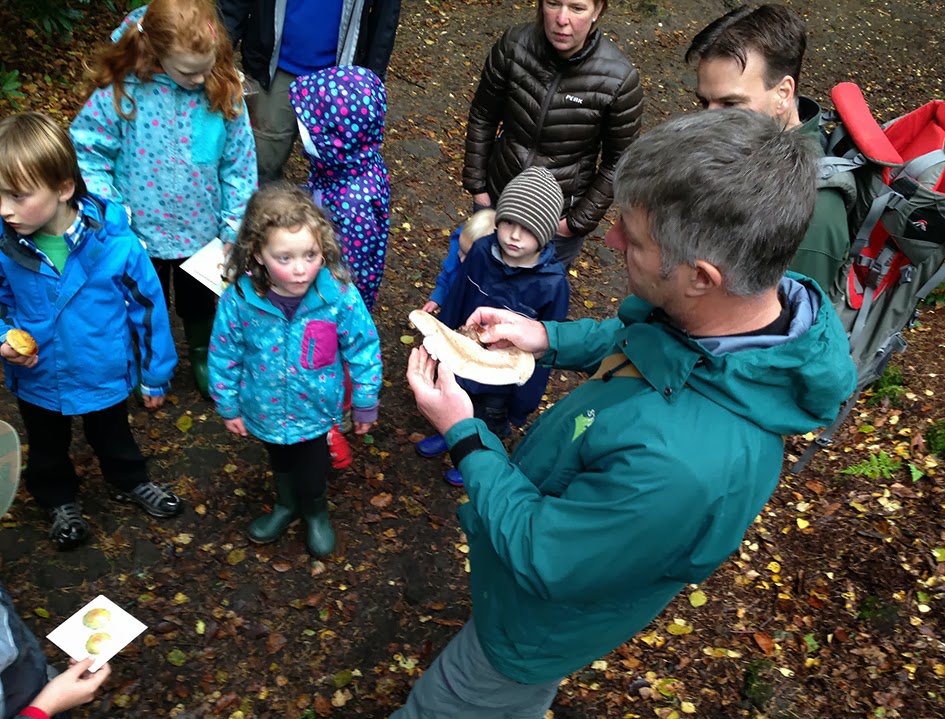
Learning about the huge Brown Birch Bracket fungus (Piptoporus betulinus)
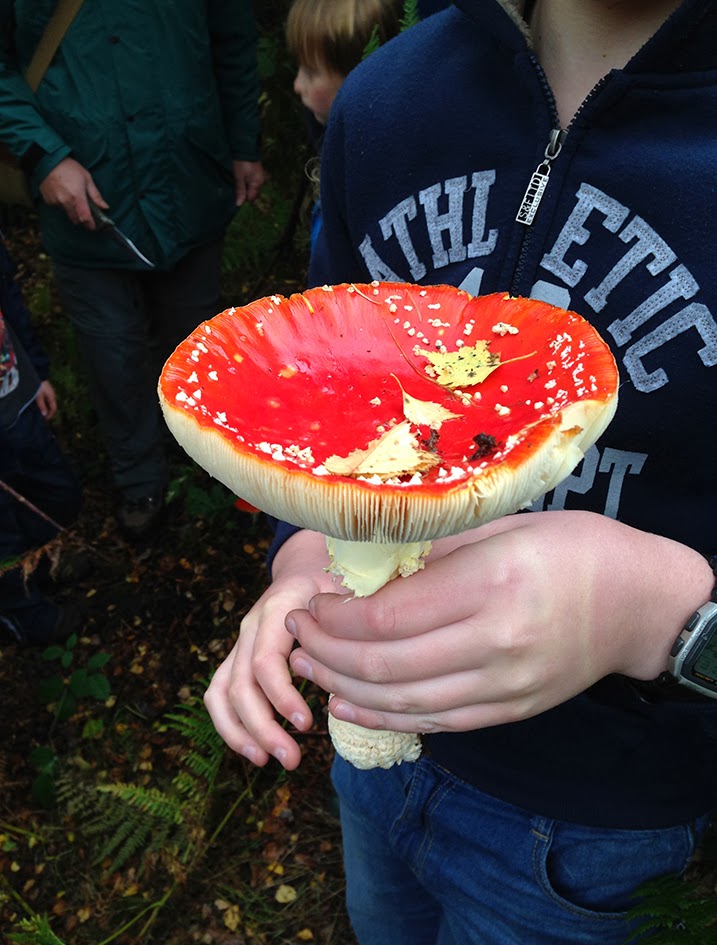
 No fungi foray would be complete without finding a Fly Agaric (Amanita muscaria)

As we reached the end of the walk a couple of people walked past with carrier bags of mushrooms they had picked for the table – so we weren’t the only ones out looking for mushrooms!

Thank you to everyone who braved the weather and we hope you enjoyed it as much as we did.

Tuesday, 10 September 2013

Bat Walk - Saturday 14th September

We gathered at the St Ives visitor centre for our bat walk. It was a warm(ish), dry evening, which is ideal, as bats cannot “see” in the rain and so don’t come out to hunt.

British bats include 18 species – all of them quite small.  The largest is the Noctule bat which is still smaller than the palm of your hand. They are all insect-eating - or insectivorous - nocturnal, flying mammals. The most interesting thing about them is how they “see” so well in the dark that they can catch flying insects. They do this by “echolocation”, locating things by their echoes. To do this, bats make shouting sounds. The returning echoes give the bats information about anything that is ahead of them, including the size and shape of an insect and which way it is going.

As ever, the first bat was spotted before it even got dark. As with humans, it seems, there is always one breaking the rules!

We had a quick safety briefing and check on torches and checked our numbers – as we didn’t want to lose anyone when it got dark! Next we handed out bat detectors, which are small boxes which translate the bats’ high-pitched squeaks into sounds we can hear. Then, as the dark thickened around us, we set off up Cross Gates Lane behind the golf club, towards some ‘inviting’ derelict barns.

At the barns the detectors soon picked up bat activity in series of short, sharp stutters, but the bats themselves were harder to see. With a few torches up in the trees, we soon spotted the Pippistrelle bats. They were flying just under the canopy of the trees – where the branches spread over the lane to form a long high “tunnel” and the insects shelter from the breeze.

After watching and listening at the barns we moved back down the lane and on to Coppice pond, where the water attracts lots of insects and we were able to hear Daubenton’s bats - the “water bat” - moving out over the lake.

The bat species can be told apart by their behaviour and the frequency of their calls: how high or low they squeak. Though we did not find it easy to differentiate many species, there was lots of bat activity to keep us occupied.

As a bonus to the evening, one of our younger members pointed out that there were small fish close in to the lake shore and we saw a few boldly striped perch. We also saw lots of crayfish in the shallows.  These are small, fresh-water lobster-like crustaceans. Their presence in numbers is encouraging, as St Ives have undertaken work to encourage the endangered white-clawed crayfish in Coppice Pond.

There is lots of information about bats on the web, if you are interested.  Here are two for starters:
Thank you to everyone who joined us. We hope you enjoyed the event and learned lots about our bats too.

Thursday, 18 July 2013

Denso-Marston Nature Reserve, Baildon - Sunday 14th July

A big thank you to everyone who came to our event at Denso-Marston Nature Reserve on Sunday 14th July. We had a great turnout and great weather!

Opening the moth traps

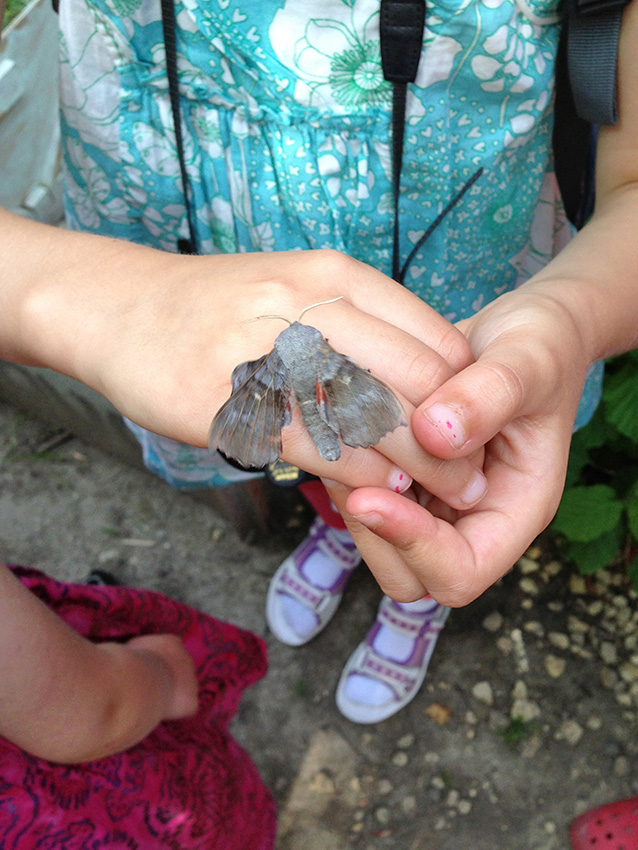
Reserve warden Steve Warrillow made us very welcome, as always. First, Steve suggested we open the moth traps. It's always exciting, because you never know what you might find! The most abundant moth we found was the Poplar Hawk-moth, just as it was at our last event at Rodley Nature Reserve.

Poplar Hawk-moth

There were plenty of moths in the traps, and the two most beautiful were probably the Buff Arches and the Burnished Bronze.

Burnished Brass moth

Next up was... Bug hunting! We were kitted out with large butterfly nets and sent around the reserve to catch anything that moved (or didn't move, for that matter). We found several Harlequin Ladybirds, including their tiny larva. The larval stage of a insect in the stage between the eggs and the full grown adults, such as caterpillars (butterflies and moths), maggots (flies), and those scary-looking creatures in ponds that become dragonflies.

Bug hunting

We found the larva of the Peacock butterfly, which feed on nettles. These are striking black caterpillars with spangly silver stars on them.

Peacock butterfly larva

We also caught some Ringlets (small dark butterflies with pretty ring shapes on their wings), soldier beetles, and all kinds of other tiny bugs.

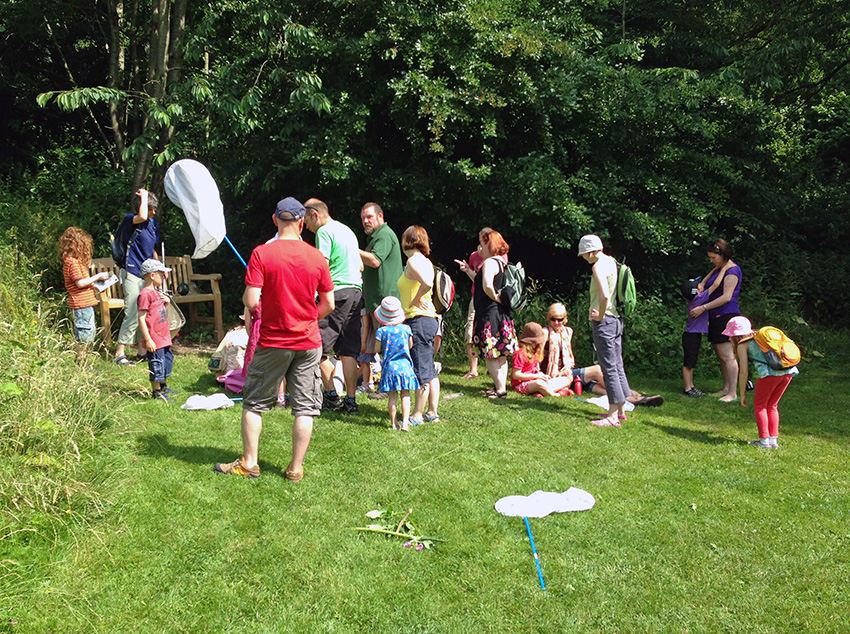
As we walked around the reserve Steve explained to us about Himalayan Balsam, a plant introduced into the Britain which doesn't really belong here. It grows here so well that it takes all the space a light, making it difficult for other plants to grow. They have attractive flowers, but many nature reserves have to remove them to help our native plants.

Steve explains why we have to remove Himalayan Balsam

Finally we did some brilliant pond dipping. Amongst the many creatures we found were water boatmen, diving beetles, damselfly larvae, leeches, tadpoles, froglets, and tiny young smooth newts. The young newts have feathery plumes at the side of their heads. These are their gills, which will be replaced by internal lungs (like ours) when they become adults.


 Pond dipping

All the while a young Moorhen called out from the pond, and a fantastic Brown Hawker (a type of large dragonfly) zoomed around over our heads. Cam found the skin of a Brown Hawker nymph, possibly from the very dragonfly we could see flying around. This skin cast (called an exuvia) is the skin of the dragonfly while it's underwater in its larval (or nymph) stage. The dragonfly nymph crawls out of the water a pushes itself out of the old skin and pumps up its wings to become a fully adult dragonfly.

The skin of a Brown Hawker nymph

Thanks again to all the children and parents who came along. The Airedale Otters now have their annual break for the summer holidays. Our next event is a Bat Walk at St Ives, Bingley, on Saturday 14th September.

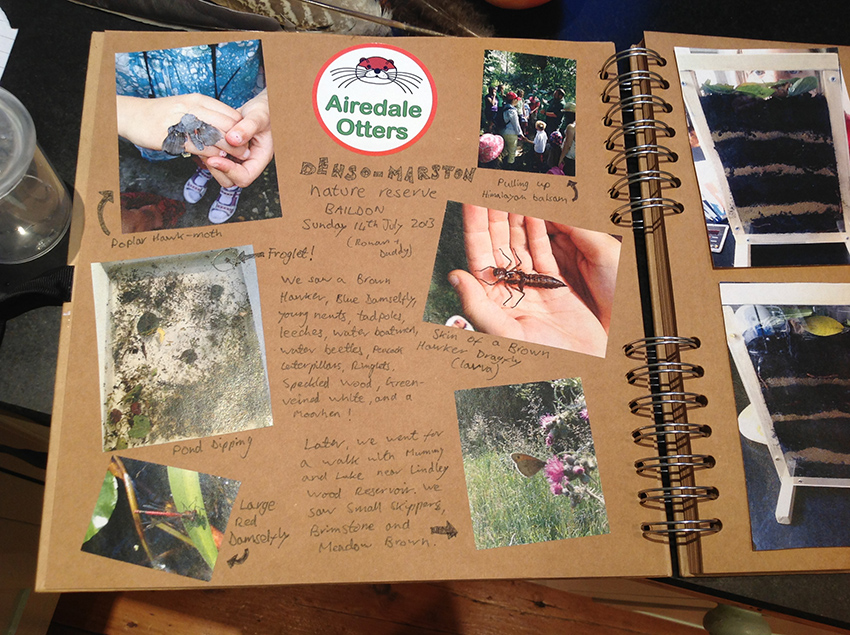
In the meantime we hope you all have a great summer holiday, and hopefully find lots of interesting wildlife on your travels or closer to home. Please bring any interesting stories or items you've found to our next event. Why not keep a nature scrapbook, recording any the interesting wildlife you see? Here's one we've started at Airedale Otters HQ:

Why not keep a nature scrapbook like this one?

Wednesday, 5 June 2013

Springwatch Day at Rodley Nature Reserve - Saturday 8th June

Thanks to everyone who came to the  Springwatch event at Rodley Nature Reserve with the Airedale Otters. It was an early start - 8:30 am - but worth it. We couldn't have asked for better weather, or better wildlife - we had moths, mammals, birds, butterflies, dragonflies, newts, and all kinds of mini beats from the pond!

The first event of the day was to open the moth traps. Peter Murphy from Rodley Nature Reserve helped us put names to the each moth as it was taken from the trap. The trap doesn't hurt the moths, it simply uses a bright light to attract them, after which the moths settle down for a rest on the egg boxes placed inside.

Opening the moth trap

One of the first moths out was a fantastic Elephant Hawk-moth! Pink and green - wow! The "Elephant" part of the name comes from the when the insect is still a caterpillar, because it has a trunk-like section just behind its head. The biggest moth we found was the Poplar Hawk-moth - there were three of these in the trap. One of the most striking moths was the White Ermine, which did indeed look as if it was made of a stoat's winter fur (used to trim royal gowns).

Here are just some of the moths we saw:

Elephant Hawk-moth

Poplar Hawk-moth

Common Swift Moth

Silver Ground Carpet Moth

Small Magpie Moth

White Ermine Moth

Buff Tip Moth

Next, mammal experts John and Maxine took around the reserve to open the mammal traps they had set the night before. Most of the traps contained either a Bank Vole or a Wood Mouse (sometimes called a Long-tailed Field Mouse). It was a great opportunity to see the differences between these two mammals: the Bank Vole is large with grey-brown fur, whereas the Wood Mouse is smaller but has bigger eyes and ears and a longer tail, with more chestnut-brown fur.

 Opening the mammal traps

Bank Vole

 Wood Mouse

Wood Mouse

Another Wood Mouse

The group then split up as more events happened around the reserve and people went to have picnics. We had a great time at the pond-dipping pool, fishing out tadpoles, caddisfly and damselfly larvae, water boatmen, diving beetles, and small fish.

Pond dipping

While eating our picnic, we watched a pair of Common Whitethroat (a small songbird, part of the warbler family) flying to and fro across the dragonfly pools. They were bringing food to their chicks in a nest hidden in the long grass by a pond.

Small Tortoiseshell Butterfly

In one of the dragonfly conservation ponds we spent a fascinating half hour watching newts. We were allowed to get one out with a net to have a closer look at it and we were able to identify it as a smooth newt, which is the commonest UK newt.

 Smooth Newt

Whilst watching the newts, we spotted something large and pale, writhing around in the pond; on closer inspection, we discovered that this was a luckless dragonfly larvae, being devoured by a newt (rather larger than the newt in the photo).  The head of the dragonfly larvae was in the newt's mouth but it put up a good fight as dragonfly larvae can be quite aggressive themselves and even eat small fish! But then two more newts came along to join in the feast and, from that point on, the dragonfly larvae didn't really stand a chance!  Being a dragonfly is obviously a risky business - we also saw this dragonfly with only three wings, which had probably had a run in with a hungry bird.

 Broad-bodied Chaser (female)

Cardinal Beetle

A fantastic day out thanks again to everyone who attended, and a big thanks to the staff and volunteers at Rodley Nature Reserve.

Thursday, 14 March 2013

Otter Walk, Bingley - Saturday 9th March

It was cold, wet and the forecast was for snow. The weather prompted a late change of meeting point, so we met in the Bingley Market car park close to the river and Myrtle Park. Our aim was a tall order - to find evidence of an elusive, nocturnal animal – our namesake the Otter!

Throstle's Nest stone - River Aire, Bingley

We descended the steps to Throstle’s nest and started to scan for exposed boulders in and at the edge of the river. Otters scent-mark their territory with spraint (poo!) in much the same way as other mammals like cats and foxes do. This might warn travelling otters that there is a resident on that stretch, either to attract a potential mate, or warn off competition.  It may also serve as a “calling card” for otters moving through an area to advertise their presence.

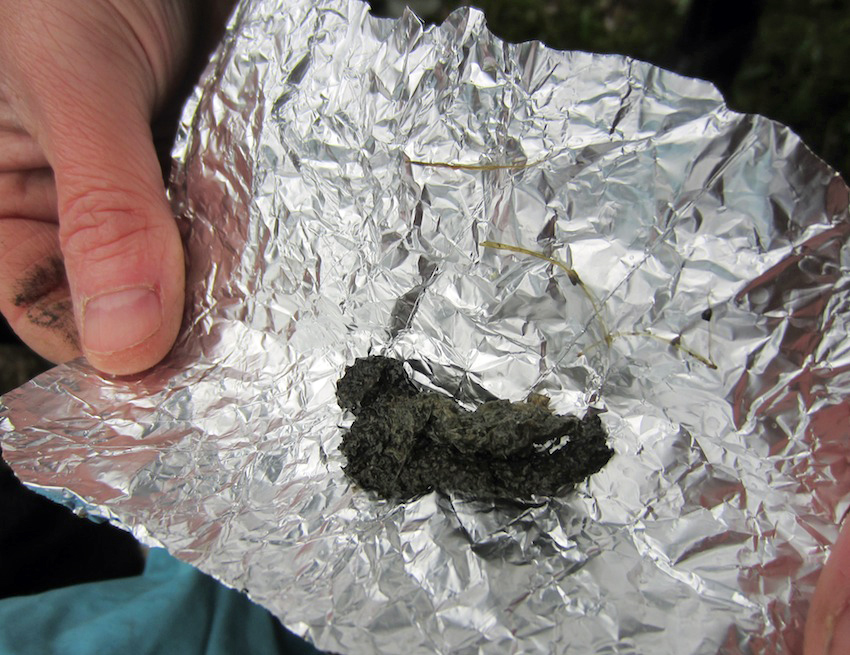
The spraint is thought to inform otters about age, sex, health and diet of the marking animal. It is black, 3 to 10 cm and flecked with bones and scales from the otter’s lunch!

Our first bird sighting was a grey wagtail, then another.  Next was a Wren (whose scientific name is Troglodytes troglodytes, which means "cave dweller" in Latin), scouting around the under-cut river bank. A short distance on, and only a stone’s throw from the town centre, we found some Otter spraint on a boulder in the water.

Cam prepares to get the spraint from the boulder

The Otter spraint - you can see the fish bones we found in it on the foil

The only way to experience the distinctive scent of an Otter spraint is to give it a sniff!

We found more 50m on and then crossed the river to check a sand bar for prints.  No otter, but a smaller 5-fingered print, probably a mink.  We also saw a single Fallow deer print (did it hop?!).

Mink tracks - Myrtle Park, Bingley

Our walk then took us up into Mouse Wood above the river, heralded by two woodpeckers, calling from the tree tops and startling a colourful Jay.  A deviation up Harden Beck revealed more otter sign, though Cam nearly had an ‘early bath’ collecting it.  So we know they travel up the smaller water courses feeding the river Aire.

Apart from a flock of Siskins high in the birch trees and a quick team photo on the Beckfoot Bridge, that was our lot.  We were all surprised at how much evidence of our otters we had found. Otter has made an incredible recovery from hunting, pollution and habitat loss and I have looked forward to their return since I was a child, so this was a warming event, on a cold day!

The Airdeale Otters at the end of a successful Otter spraint search!

Thank you to everyone who braved the weather and we hope you enjoyed it as much as we did.

Monday, 21 January 2013

RSPB Big Garden Birdwatch at St Ives, Bingley - Sunday 27th January


Thanks to everyone who turned up on Sunday 27th January to help out with the Big Garden Birdwatch survey. It is a really important survey, which helps the RSPB understand how well the birds are doing and gives us a ‘snapshot’ of bird numbers across the UK.


 Team talk

The snow had completely disappeared by the time we arrived at St Ives on Sunday morning but it was still a bitterly cold morning in the bird hide! But the excitement of seeing lots of different birds landing on the feeders and on the ground was enough to help take the hardy Otters’ minds off the cold.  The Otters leaders had been out on the Saturday and earlier on Sunday morning, putting out lots of tempting treats on the feeders and the ground for the birds. The birds could choose from peanuts, a variety of seeds, meal worm, fat balls and some of the feeders made at the Otters Christmas event – a real feast!  

And it was worth it. It is difficult to say precisely how many birds we saw because you have to try not to count the same bird over and over again but, in the hour we were there, we saw 14 different species, for a total of about 32 birds. The Otters all came armed with notebooks, pencils, bird identification books and binoculars to help us to be as accurate as possible.

The Nutchatches were the first to take advantage of all the food on offer and many of the Otters will now be expert at recognising this plump little bird with blue-grey feathers on its back, orange breast, and long black pointed bill, as at least four of them were constantly flying in and out to the feeders the whole time we were there. We saw three species of tit  – the smaller greyish Coal Tit, recognisable by the way it flits in, snatches a seed and flies out again, the larger Great Tit, with its distinctive glossy black head, and the familiar Blue Tit with its colourful mix of blue, yellow, white and green. 


 Nuthatch (photo Stephen Lilley)

The stars of the show, however, were the beautiful Jays. We recorded three of these striking birds, the most colourful members of the crow family. Normally they are quite difficult to see and it is usually their screaming call, which lets you know there is one about. But on Sunday, they put on a real show for us, as they couldn’t get enough of the peanuts that had been scattered all over the ground for their enjoyment! 


Jay (photo Stephen Lilley)

We saw five Blackbirds – including males and females and all the Otters should now be able to explain the difference! Right at the end of the hour, Nick spotted a Treecreeper and no prizes for guessing what it was doing – yes you’ve got it – it was creeping up a tree, looking for insects. This behaviour and its long curved bill make the Treecreeper easy to recognise once you’ve spotted it!


The list of birds

Other visitors to the hide area that morning were Robins, Chaffinch, Magpie, Dunnock, Wren and Song Thrush. The full list of birds recorded by the Airedale Otters is below - click on a link to learn more about the bird:
The total of 14 species was not as high as the number of species we identified in our bird race last spring, as it was too early in the year for the summer visitors.  But all in all, a good day’s work for a cold January day, so well done Otters! The RSPB will publish the Big Garden Birdwatch results later in the year.