Wednesday, 11 June 2014

June Wildlife Day, Rodley Nature Reserve, Leeds - Saturday 14th June 2014

This was another great event at Rodley Nature Reserve. There's always lots to see and do at this excellent child-friendly reserve between Bradford and Leeds.

First, we watched as the reserve staff opened the moth traps they'd set the night before. As usual, we found a really wide array of moths, from the drab grey-brown ones to dazzlingly coloured ones.

Elephant Hawk-moth

Burnished Brass Moth

Buff-tip Moths

Beautiful Golden Y Moth

We then embarked on a small mammal survey, going around the whole reserve finding and emptying mammal traps. Field Mouse and Bank Voles were in the traps most often, although we found a tiny young toad in one!

Opening the mammal traps

Field Mouse

Bank Vole

The day continued with more events: a bird walk, a wild flower walk, pond dipping, and a trip to the reserve's fish pass During our visit we saw some great birds, including two Red Kites, a Great Crested Grebe sat on a nest, and three pairs of Common Terns with chicks.

Red Kite

Great Crested Grebe

Common Tern with chicks

Thanks to everyone who came to this fabulous event, and special thanks to the staff and volunteers of Rodley Nature Reserve for making us so welcome.

Wednesday, 30 April 2014

Bird Race at St Ives, Bingley - Sunday 11th May, 10:30am

Thank you to the Otters who braved the wet weather forecast and joined us on our annual bird race.

The low turnout didn't dampen our enthusiasm - and neither did the weather in the end, which stayed dry if a little windy.

The winning team, lead by Nick and Joost, amassed a total of 33 bird species in a one-hour walk around the estate. This beat Cameron's team by four, in what were difficult conditions. Both teams started at the bird hide near Coppice Pond, and took a circular route around the estate, going in opposite directions.

The Airedale Otters Bird Race Cup winners 2014

The full list of species seen or heard, in the order spotted, is:
1. Mallard
2. Canada Goose
3. Magpie
4. Greylag Goose
5. Moorhen
6. Coot
7. Blackbird
8. Wren
9. Willow Warbler
10. Blue Tit
11. Nuthatch
12. Great Tit
13. Starling
14. Goldfinch
15. Mistle Thrush
16. Robin
17. Wood Pigeon
18. Blackcap
19. Dunnock
20.Swallow
21. Jackdaw
22. Pied Wagtail
23. Chaffinch
24. Carrion Crow
25. Kestrel
26. Pheasant
27. Little Owl
28. Curlew
29. Swift
30. Common Whitethroat
31. Skylark
32. Chiffchaff
33. Coal Tit

Friday, 18 April 2014

Spring Wildlife Walk, Hirst Wood, Saltaire - Sunday 13th April 2014

Thank you too all the enthusiastic Otters and their families who joined us on our Spring Wildlife Walk on Sunday 13th April.

We met at Hirst Wood car park in the sunshine, and watched Long-tailed, Great and Blue Tits as we waited for everyone to arrive. The weather was just about perfect for a spring walk, though the strong breeze made viewing birds high up in the trees a bit harder.

Wildlife Explorers!

No sooner had we entered the wood and we were hearing Nuthatches calling. It wasn't long before we saw one, the first of four we saw. These loud "mini woodpeckers" are very handsome birds, with blue-grey backs, orange bellies, and a cool stripe through the eye. They get their name through their habit of cracking open nuts with their dagger-like bills.

Watching a Nuthatch

We were trying to find birds not just by looking for them, but also by listening for their songs. We heard a lot of Blue Tits, Wrens, Blackbirds and Robins in the wood, but before long we heard a sweet, rich warble coming from over our heads. It was a male Blackcap. Blackcaps are summer migrants from warmer parts of Europe and Africa, but more recently some Blackcaps have been spending the winter in Britain. So the bird we saw in the wood may have flown just flown in from Africa, or spent all winter in our gardens.

We moved on, with the Otters finding noisy Jays and Mistle Thrushes. We stopped at the aqueduct end of the wood, to listen for birds. It was a bit windy here, but we were lucky to spot a pair a Stock Doves at what was probably their nest site in a nearby tree. Stock Doves look similar to Wood Pigeons, but are more closely related to the feral pigeons you see in towns are cities. Stock Doves live in fields in small flocks, and pair up in spring to build nests in holes in trees. They are often overlooked, and are possibly the prettiest pigeon or dove we have in the UK.

Stock Dove

We continued to the aqueduct, which led us to Dowley Gap Water Treatment Plant. We could see the Swallows and Sand Martins flying over the works from a distance - the first Swallows we'd all seen since last summer. They had been in southern Africa over the winter, and it was great to see them back. Sites like sewage works attract birds that feed exclusively on insects, and so are great for birds like Swallows, Sand Martins, Pied and Grey Wagtails, Wrens, Chiffchaffs, etc.

Over the canal and on to the river heading back and the Otters found a group of Mallard ducklings! There were eight ducklings in one family group. Most birds are still building nests or sat on eggs, but these Mallards had started early. The ducklings looked like they'd been out of the nest for around week already.

 Finding the Mallard ducklings

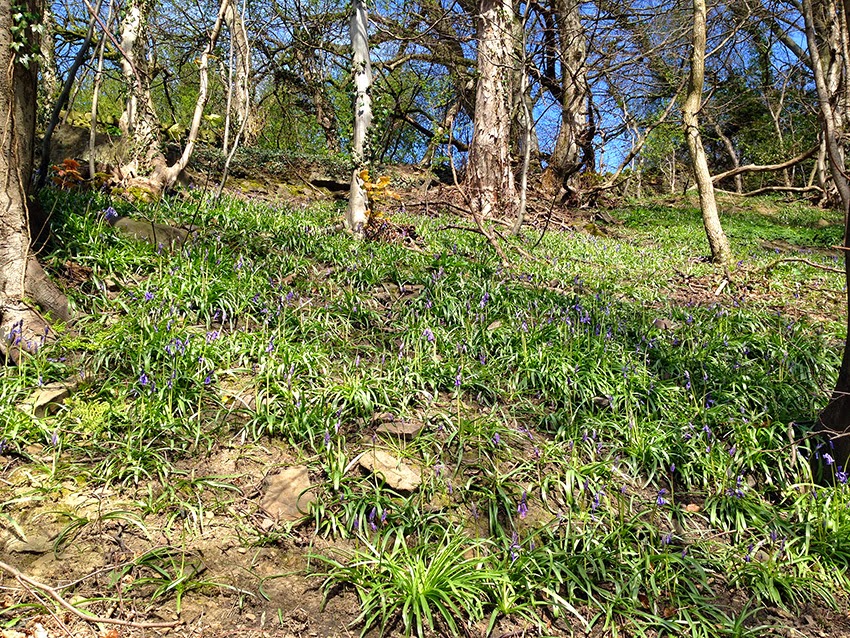
Along the river we heard singing Chiffchaffs in the trees - calling their name "chiff-chaff-chiff-chaff". The river bank was coated in early flowers like Celandine, Bluebell, and Wood Anemone, and the scent of Wild Garlic.

 Bluebells

Wild Garlic and Celandine

We also saw an early Orange Tip butterfly. It was a male, which has orange wing tips - females are all-white. A large shoal of small, or young, fish were swimming in the shallows. Unfortunately, none of us what these were. A definite gap in Airedale Otter knowledge! Perhaps something to do in a future event or quiz...

Orange Tip butterfly

At the weir we were greeted by a Grey Wagtail and soon found a pair or Dippers catching insects in the river. We watched as they flew out from the bank and plopped into the river, disappearing under water! Dippers can walk under water, gripping onto stones with their feet and catching the insect larvae. The Dippers were carrying the food back up the stream - as sure sign they have hungry young birds in the nest.

A great walk - thanks again for taking part.

Wednesday, 2 April 2014

Building a Dead Hedge in Cullingworth - Sunday 23rd March

Thank you to everyone who came and helped us build the dead hedge at The Dell Woodland in Cullingworth on Sunday 23rd March. The weather was perfect: sunny, dry, and still.


It was great to be getting involved in some practical conservation work, helping to give nature a home in a local community woodland. A dead hedge is made up of cut branches and stems piled up to form a barrier.

Getting started

First we placed strong stakes in the ground, like fence posts. Then we gathered branches, sticks and twigs and weaved these between the posts, making the structure stronger.


Everyone pitched in

The dead hedge soon started to take shape

A dead hedge is like a special den for all sorts of creatures. It will become home to a wide range of invertebrates (bugs and mini beasts), amphibians (frogs and toads) and small mammals (such as mice and voles). It will also help improve conditions for birds, providing a good perching spot for smaller birds.


We made good progress

As well as providing a great habitat for the wildlife, our dead hedge will be an important barrier between the woodland and the houses that back on to it and look much more natural than an ordinary fence. Over time, material in the dead hedge will slowly rot down returning important nutrients to the soil and new cuttings and branches can be added to it.


The finished dead hedge looked great

The finished dead hedge looks brilliant. Well done everyone! You earned the hot chocolate and biscuits! We had some great views of a Grey Wagtail, which was buzzing around the stream in the wood, calling loudly. This noisy cockerel was also calling loudly!


Wednesday, 29 January 2014

RSPB Big Garden Birdwatch at St Ives, Bingley - Sunday 26th January 2014

Thank you to all who attended the Airedale Otters Big Garden Birdwatch event at St Ives on Sunday 26th January. This is a really important survey, which helps the RSPB understand how well the birds are doing and gives us a ‘snapshot’ of bird numbers across the UK. The weather was extremely wet, but those who braved the rain were rewarded with some great birds, excellent views of Grey Squirrels, and hot chocolate and hot Ribena and biscuits!


The rain was at its heaviest as we arrived, but eased off during the hour of the survey. The Otters leaders had been out on the Saturday and earlier on Sunday morning, putting out lots of tempting treats in the feeders and on the ground for the birds. The birds could choose from peanuts, a variety of seeds, apples, and fat balls.

Armed with notebooks, pencils, bird identification books and binoculars, we recorded 15 different species, one more than last year.

Blackbirds were the first to take advantage of all the food on offer, mostly feeding on seeds on the ground. We saw six in total – including males and females and all the Otters should now be able to explain the difference!

We saw four different members of the crow family. A large black Carrion Crow was high in the tree to the right of the hide, and we noticed a Jackdaw flying in by first hearing it's call: "Jack! Jack!". A black and white Magpie flew around the feeding area, often landing on the fence. We spotted a large bird with a large white rump (the area between the tail and back on a bird) flying through the trees at the back of the feeding station. It was a Jay, the most colourful member of the crow family in the UK.

A Great Spotted Woodpecker was moving around around high in the trees to the left of the hide - a common bird in these woods, but always a joy to see. We could also hear the high-pitched call of a Treecreeper nearby, but unlike last year we couldn't locate it.

We saw four species of tit, one more than last year  – the black, white and pink Long-tailed Tit with its distinctive call and tail; the small greyish Coal Tit, recognisable by the way it flits in, snatches a seed and flies out again; the larger Great Tit, with its distinctive glossy black head; and the familiar Blue Tit with its colourful mix of blue, yellow, white and green.

But it was the Grey Squirrels who put on the best show. There was at least one feeding always close to the front of the hide, and at one point we had four feeding on the ground and bird tables.

Grey Squirrel, St Ives, Bingley - Sunday 26th January

Other visitors to the hide area that morning were Robins, Dunnocks, Collared Dove, and Woodpigeon. The full list of birds recorded by the Airedale Otters is below - click on a link to learn more about the bird:
All in all, a good day’s work for a cold January day, so well done Otters! The RSPB will publish the Big Garden Birdwatch results later in the year.  

Monday, 2 December 2013

Airedale Otter Christmas Event, St Ives, Bingley - Sunday 8th December 2013

A big thank you to all our members and their families who came to the Airedale Otters Christmas Event at St Ives on Sunday 8th December.

We started at the visitor centre with a demonstration of woodturning by the West Riding Woodturners Group. It was really interesting for Otters to see how wood can be worked into useful and decorative items using traditional methods. The kids also got to take home games and ornaments made from turned wood.

Woodturning at St Ives Visitor Centre - Sunday 8th December 2013

Heading out for our walk - Sunday 8th December 2013

Continuing the wood and tree theme, we then went on a winter scavenger hunt, looking in particular for different types of tree. Identifying trees isn't as easy in winter as it is in summer, when the trees have their leaves. But, there there are still plenty of clues we can use to help us. Each different tree species tends to have a unique shape, so we can make a good guess at the species just by looking at the tree's silhouette. The bark's colour and texture is another really important clue. Underneath the tree you can look for clues such as dead leaves and fallen fruit, such as conkers from Horse Chestnut trees, acorns from Oak trees, and berries from Holly, Hawthorn or Rowan.

Different tree species can also have different buds on their twigs. The twigs may have thorns, and can branch in different ways depending on the species: opposite each other, or alternating left and right. So you can identify a tree just from a small stick found on the ground!

There were quite a few Black-headed Gulls on Coppice Pond, although none of them had black heads! This is because the birds only have black heads in spring and summer, and moult into different feathers in the autumn, so during winter their heads are mostly white with a small black dot behind the eye. We also saw Mallards, Canada Geese and Moorhens on the pond.

 Canada Goose with Mallards at St Ives - Sunday 8th December 2013

We finished at the bird hide for snacks and mince pies, and hot juice and mulled wine. There were a few visitors to the feeders, including tiny Coal Tits. Coal Tits rarely hang around on the feeders. They like to fly in, quickly grab some food, and immediately fly off into cover to eat. We had some Blue Tits too, who are never as shy as the Coal Tits, plus the ground-feeding Dunnock. We were lucky to see two Nuthatches, if only briefly. And of course, no Christmas birdwatch would be complete without a Robin, and one sat in the fallen pine tree branch in front of the hide - a very festive scene.


Drinks and snacks at the bird hide - Sunday 8th December 2013

Once again, thank you to everyone who came and made it such fun event.

Monday, 4 November 2013

Checking Nestboxes in Deep Cliff Wood, Saturday 16th November

We had another fascinating event at Deep Cliff Wood in Harden on Saturday 16th November, as we cleaned out the nest boxes we made in January 2012, getting them ready for the breeding season next spring.

Checking inside one of the nest boxes

One of the best things about opening the next boxes is you never what what you're going to find. Here’s a full list of what we found this year (and last year's results for comparison):

Box Number 
What we found this year (2013)
What we found last year (2012)
1
Empty and clean
Bird poo!
2
Empty and clean
Empty and clean
3
Complete Blue Tit nest (no eggs found)
4
Empty and clean
Partially-built nest
5
Empty and clean
Bird poo!
6
Partially-built Blue Tit nest
Blue Tit nest with two eggs
7
Empty and clean
Partially-built Blue Tit nest.
8
Empty and clean
Empty and clean
9
Empty and clean
Empty and clean
10
Blue Tit nest with one egg
Successful nest
11
Empty and clean
Empty and clean
12
Empty and clean
Blue Tit nest and bird poo
23
Successful Blue Tit nest
Blue Tit nest with three eggs (one hatched)
DJM
Empty and clean
Partially-built Blue Tit nest.

Last year, out of the 14 nest boxes, we found at least ten of them had been used. This year, we found only four had been used. What's going on? We don't know for sure, but we have some ideas.

This year, the spring was very cold (it felt like winter would never end!), but we had a lovely warm, dry summer. By the time the warm weather arrived, it's possible many birds had decided it was too late to begin breeding. In 2012, the summer was very cold and wet, whereas the early spring was very warm. It's possible that birds started nesting early but abandoned their nests as the weather became colder and wetter.

We may never know, but by continuing to monitor the nests and comparing the records from one year to the next we may be able to see some patterns in the birds behaviour. It interesting to note that the four nest boxes that were used this year were also used last year. All of the boxes that we found empty last year were empty again this year.

The good news is in nest boxes 3, 10, and 23 we found complete Blue Tit nests. It is likely the birds in these nest boxes successfully raised families!

Nest box 3

The Blue Tit nest from nest box 3

Looking at what we found in nest box 10

The Blue Tit nest and egg from nest box 10

The Blue Tit nest from nest box 23

Nest box 6 contained a partially-built Blue Tit nest. Birds stop building nests for several reasons: maybe one of the parents were injured or killed (possibly by a predator like a Sparrowhawk), or maybe they were struggling with the early cold weather. If, the birds were struggling to find food or keep themselves warm, they may have decided to stop and try again later when the weather improved. Building a nest, laying eggs, and then raising a family is very hard work for a small bird. They will only carry on if they have a realistic chance of raising at least one chick.

All the other nest boxes were empty and clean. Here's hoping these will be used next year.

Whilst looking around we found lots of different types of fungi. This weird-looking black fungus is called Dead Man's Fingers, and you can see why! This fungus often grows on dead Beech trees.

Dead Man's Fingers - Deep Cliff Wood, 16th November 2013

Some Airedale Otters found a couple of Beech trees which had been 'girdled' or 'bark ringed'. This means a strip of bark has been removed from around the entire circumference of a trunk of a tree, killing the tree. Foresters and tree surgeons sometimes use this technique to kill unwanted or damaged trees and thin out a wood or forest. The Otters noticed what looked like red paint above the area where the bark had been removed. On closer inspection we found this was actually a fungus: Red Coral Spot fungus.

Red Coral Spot fungus - Deep Cliff Wood, 16th November 2013

Like last year, we Common Earthball fungus, which often grows near Birch and Oak and there are plenty of those in Deep Cliff Wood. We also found Fairies Bonnets and and Birch Bracket Fungus.

Common Earthball - Deep Cliff Wood, 16th November 2013

Fairies Bonnets - Deep Cliff Wood, 16th November 2013

Birch Bracket fungus - Deep Cliff Wood, 16th November 2013

We also found lots of acorns, which not surprising given the number of Oak trees in the wood. Many of them were germinating - the acorn sprouting roots and shoots, beginning to grow into an Oak. There were two sites in the wood where we found lots of acorns and hazel nuts that had been eaten, probably by a Grey Squirrel. It was interesting that whoever had eaten the acorns, they had chosen a specific place in the wood to eat them.

Germinating acorns - Deep Cliff Wood, 16th November 2013

Who's been eating eating these acorns?

We finished the event with a fascinating and challenging tree quiz: matching the fruits (such as conkers, acorns, haws and rowan berries), with the leaves from the corresponding trees. Tricky, but lots of fun. Well done everyone who took part - we all learnt a lot of new facts about trees.

 Quiz time!