Monday, 2 March 2015

Preparing our nestboxes for the new season

The Airedale Otters leaders recently visited Deep Cliff Wood in Harden to clean out the nestboxes ready for the 2015 breeding season. We placed 14 nestboxes in the private wood in January 2012 and have checked and cleaned them every year since then.

 Cleaning a nestbox - Deep Cliff Wood, Harden, February 2015

While we clean the nestboxes we also check to see if any have been used in the previous breeding season, and by which species. The results for the previous years can be found here: 2012 and 2013. The contents of the nestboxes this time will be from the 2014 breeding season.

Here’s a full list of what we found this year:

Box number
What we found
1
Bird poo!
2
Partially-built Great Tit nest.
3
Probable Nuthatch nest
4
Empty and clean
5
Bird poo!
6
Empty, though with some grass and poo
7
Empty and clean
8
Complete Blue Tit nest
9
Empty and clean
10
Partially-built nest
11
Empty and clean
12
Bird poo!
23
Complete Coal Tit nest
DJM
Complete Blue Tit nest 

The results are very similar to previous years, with at least three completed nests and two partially-built nests. Box 23 had our first Coal Tit nest. For the first time, we didn't find any unhatched/failed eggs.

The most interesting find was in box 3. The bottom of the box was filled with bark and soft, dry, rotten wood from a silver birch - up to a depth of 50mm (about 2"). The most likely candidate for this nest is the Nuthatch, which we have seen and heard plenty of in the surrounding woodland. Let's hope they come back and nest again this year.

 Nuthatch (photo Stephen Lilley)

We also found this discarded bottle full of moss in the wood. The moss, which would normally struggle to find sunlight under all the fallen leaves, had grown in the bottle - using it like a greenhouse.

 Moss growing in a milk bottle - Deep Cliff Wood, Harden, February 2015

Because the bottle was on top of the leaves, the moss could have as much sunlight as it needed; while the bottle created a moist micro-climate, just as the moss prefers. It's amazing what nature can do!

Friday, 16 January 2015

Big Garden Birdwatch 2015 at St Ives - Sunday 25th January

We once again took part in the RSPB's Big Garden Birdwatch for our first event of the year.

As in previous years, we met at the bird hide in St Ives (next to Coppice Pond) at 10:30 and spent an hour counting the birds visiting the feeders. The Airedale Otters leaders had placed food out for the birds before the event to ensure we would attract as many species as possible.

This year we recorded fewer bird species than on previous years -  this is probably because the weather was milder this year - but this year we had more individual birds.


Counting the birds is great fun, and can help you improve your bird identification skills. And on the Airedale Otters Big Garden Birdwatch we have the added attraction of hot chocolate and biscuits!

We will send the result of our survey off to the RSPB so they can add it to many others that will have been done up and down the country. You can see our results from the last two years here: 2014 and 2013. The RSPB's total results for all their previous surveys can be found here.

Thank you to everyone who came and help out with this year's count.

Monday, 17 November 2014

Olly the Otter is on Twitter!


Yes, Olly the Otter is now on Twitter!

Parents, you can now keep up with the latest info on Airedale Otters events and local wildlife news from Bradford and Airedale by following us on Twitter.

Just click on the link below to follow us, or click here to visit our Twitter page.


Monday, 21 July 2014

Denso-Marston Nature Reserve, Baildon - Sunday 13th July

On Sunday 13th July we had another excellent event at Denso-Marston - a fantastic little nature reserve in Baildon.

The reserve warden Steve Warrillow welcomed us and showed us the delights of this hidden gem, which is tucked away behind a factory beside the River Aire. Just like last year, the weather and wildlife combined to great effect.

Reserve warden Steve opens the moth traps

Steve had earlier opened his moth trap and saved some of the best moths for us to see. There were some lovely species, with equally lovely names: Mother of Pearl, Smokey Wainscot, Buff Arches, and a beautiful Burnished Brass which glinted like polished gold in the sunshine.

Buff Arches Moth

Next we toured the reserve seeing many insects on the wing, such as the huge Brown Hawker dragonfly - easily recognised by its brown wings.

 A Grey Squirrel hid in a tree and waited for us to pass

In the woodland, Steve has placed several wooden boards to create spaces for mammals and amphibians. The Airedale Otters had great fun lifting up these boards, with a surprise under almost every one. On several occasions we found evidence of Wood Mouse and Short-tail Field Vole. We could tell which species had been feeding there from the bite marks on the wild cherry stones we found. We saw several Wood Mice, mostly running away as we opened the boards, though one did stay around long enough to have his photo taken!

Wood Mouse

Wood Mouse nest

Wild Cherry stones eaten by Short-tailed Field Voles

Under the boards we also found Smooth Newts, young Common Toads, a Common Frog, and a Leopard Slug.

Common Frog

Smooth Newt

Leopard Slug

Last but not least was the pond dipping. The Otters found an amazing number of species, and Steve was on hand to help us identify them. Many of the Otters proved themselves to be very knowledgeable about the pond life too. We found several young Smooth Newts, Greater and Lesser Water-boatmen, Hog Louse, Blood Worm, Flatworm, Water Mite, Pond Skater, Phantom Midge, Freshwater Mussel and Shrimp, Ram's-horn Snail, and a Whirligig Beetle (which obviously made Steve's day!).

 Pond Dipping

A really enjoyable event - thank you to all the kids and families who attended.


Wednesday, 11 June 2014

June Wildlife Day, Rodley Nature Reserve, Leeds - Saturday 14th June 2014

This was another great event at Rodley Nature Reserve. There's always lots to see and do at this excellent child-friendly reserve between Bradford and Leeds.

First, we watched as the reserve staff opened the moth traps they'd set the night before. As usual, we found a really wide array of moths, from the drab grey-brown ones to dazzlingly coloured ones.

Elephant Hawk-moth

Burnished Brass Moth

Buff-tip Moths

Beautiful Golden Y Moth

We then embarked on a small mammal survey, going around the whole reserve finding and emptying mammal traps. Field Mouse and Bank Voles were in the traps most often, although we found a tiny young toad in one!

Opening the mammal traps

Field Mouse

Bank Vole

The day continued with more events: a bird walk, a wild flower walk, pond dipping, and a trip to the reserve's fish pass During our visit we saw some great birds, including two Red Kites, a Great Crested Grebe sat on a nest, and three pairs of Common Terns with chicks.

Red Kite

Great Crested Grebe

Common Tern with chicks

Thanks to everyone who came to this fabulous event, and special thanks to the staff and volunteers of Rodley Nature Reserve for making us so welcome.

Wednesday, 30 April 2014

Bird Race at St Ives, Bingley - Sunday 11th May, 10:30am

Thank you to the Otters who braved the wet weather forecast and joined us on our annual bird race.

The low turnout didn't dampen our enthusiasm - and neither did the weather in the end, which stayed dry if a little windy.

The winning team, lead by Nick and Joost, amassed a total of 33 bird species in a one-hour walk around the estate. This beat Cameron's team by four, in what were difficult conditions. Both teams started at the bird hide near Coppice Pond, and took a circular route around the estate, going in opposite directions.

The Airedale Otters Bird Race Cup winners 2014

The full list of species seen or heard, in the order spotted, is:
1. Mallard
2. Canada Goose
3. Magpie
4. Greylag Goose
5. Moorhen
6. Coot
7. Blackbird
8. Wren
9. Willow Warbler
10. Blue Tit
11. Nuthatch
12. Great Tit
13. Starling
14. Goldfinch
15. Mistle Thrush
16. Robin
17. Wood Pigeon
18. Blackcap
19. Dunnock
20.Swallow
21. Jackdaw
22. Pied Wagtail
23. Chaffinch
24. Carrion Crow
25. Kestrel
26. Pheasant
27. Little Owl
28. Curlew
29. Swift
30. Common Whitethroat
31. Skylark
32. Chiffchaff
33. Coal Tit

Friday, 18 April 2014

Spring Wildlife Walk, Hirst Wood, Saltaire - Sunday 13th April 2014

Thank you too all the enthusiastic Otters and their families who joined us on our Spring Wildlife Walk on Sunday 13th April.

We met at Hirst Wood car park in the sunshine, and watched Long-tailed, Great and Blue Tits as we waited for everyone to arrive. The weather was just about perfect for a spring walk, though the strong breeze made viewing birds high up in the trees a bit harder.

Wildlife Explorers!

No sooner had we entered the wood and we were hearing Nuthatches calling. It wasn't long before we saw one, the first of four we saw. These loud "mini woodpeckers" are very handsome birds, with blue-grey backs, orange bellies, and a cool stripe through the eye. They get their name through their habit of cracking open nuts with their dagger-like bills.

Watching a Nuthatch

We were trying to find birds not just by looking for them, but also by listening for their songs. We heard a lot of Blue Tits, Wrens, Blackbirds and Robins in the wood, but before long we heard a sweet, rich warble coming from over our heads. It was a male Blackcap. Blackcaps are summer migrants from warmer parts of Europe and Africa, but more recently some Blackcaps have been spending the winter in Britain. So the bird we saw in the wood may have flown just flown in from Africa, or spent all winter in our gardens.

We moved on, with the Otters finding noisy Jays and Mistle Thrushes. We stopped at the aqueduct end of the wood, to listen for birds. It was a bit windy here, but we were lucky to spot a pair a Stock Doves at what was probably their nest site in a nearby tree. Stock Doves look similar to Wood Pigeons, but are more closely related to the feral pigeons you see in towns are cities. Stock Doves live in fields in small flocks, and pair up in spring to build nests in holes in trees. They are often overlooked, and are possibly the prettiest pigeon or dove we have in the UK.

Stock Dove

We continued to the aqueduct, which led us to Dowley Gap Water Treatment Plant. We could see the Swallows and Sand Martins flying over the works from a distance - the first Swallows we'd all seen since last summer. They had been in southern Africa over the winter, and it was great to see them back. Sites like sewage works attract birds that feed exclusively on insects, and so are great for birds like Swallows, Sand Martins, Pied and Grey Wagtails, Wrens, Chiffchaffs, etc.

Over the canal and on to the river heading back and the Otters found a group of Mallard ducklings! There were eight ducklings in one family group. Most birds are still building nests or sat on eggs, but these Mallards had started early. The ducklings looked like they'd been out of the nest for around week already.

 Finding the Mallard ducklings

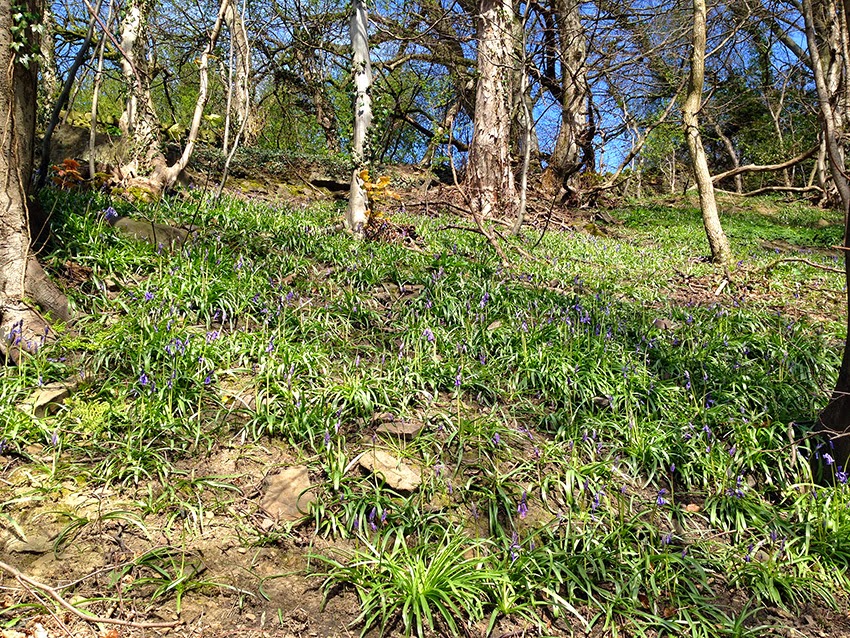
Along the river we heard singing Chiffchaffs in the trees - calling their name "chiff-chaff-chiff-chaff". The river bank was coated in early flowers like Celandine, Bluebell, and Wood Anemone, and the scent of Wild Garlic.

 Bluebells

Wild Garlic and Celandine

We also saw an early Orange Tip butterfly. It was a male, which has orange wing tips - females are all-white. A large shoal of small, or young, fish were swimming in the shallows. Unfortunately, none of us what these were. A definite gap in Airedale Otter knowledge! Perhaps something to do in a future event or quiz...

Orange Tip butterfly

At the weir we were greeted by a Grey Wagtail and soon found a pair or Dippers catching insects in the river. We watched as they flew out from the bank and plopped into the river, disappearing under water! Dippers can walk under water, gripping onto stones with their feet and catching the insect larvae. The Dippers were carrying the food back up the stream - as sure sign they have hungry young birds in the nest.

A great walk - thanks again for taking part.