Saturday, 13 June 2015

Moorland Walk, Whetstone Gate, Rombalds Moor - Sunday 7th June 2015

A big thank you to everyone who came on our Moorland Walk event. The weather turned in our favour just at the right time, and after starting out cloudy we enjoyed glorious sunshine by the end.


Our plan was to look for specialist moorland birds - ones adapted to live and breed on the exposed hills. One such bird is the Red Grouse, and it wasn’t long before one flew up from the heather beside the path and landed on a nearby wall, letting out its croaky call as it flew. These birds are adapted to keep warm and dry in cold upland areas, having round, stocky bodies with feathers covering their legs. The bird we saw appeared to be a male - these have a much brighter red “comb” above their eyes, which becomes even brighter during the breeding season.

Typical of view of a Red Grouse, hiding in the heather

Many wading birds breed on moors, such as Redshank, Curlew, Lapwing, Snipe and Golden Plover. Most people associate waders with wetlands, mudflats and the seashore. Their long legs are adapted for wading in shallow water and their long bills for probing mud and sand. Moors are often very wet and marshy, and can also be have quite sandy soil, allowing the long-billed waders to feed effectively.

A Lapwing frequently flew above us as we walked, calling as we passed a his territory, giving us great views of this beautiful bird. Sadly, the British Lapwing breeding population has been declining for a number of years, probably because of changes to farming methods. All around us we could hear the fabulous call of the Curlew - a very evocative moorland sound. We saw several flying and calling nearby, proclaiming their territories.

 Curlew, Baildon Moor (photo: Paul Marfell)

Another bird we wanted to see was the Red Kite, and it wasn’t long before Cam spotted two in the distance towards Bingley. But soon after we saw another, and much closer. A majestic bird of prey, and becoming more common in Airedale since they've been reintroduced into nearby Wharfedale over the last couple of decades. Unlike most raptors, Red Kites don’t catch and kill much live prey, other than some small mammals, young birds, and earthworms. They scavenge for carrion - dead animals - on moors and farmland and by the roadside.

Red Kite, Rombalds Moor - Sunday, 7th June 2015

Watching Red Kites and Lapwing

Another bird we wanted to see was the Golden Plover, a beautiful black, white, and golden-brown bird, and a close relative of the Lapwing. We settled down by some rocks and scanned a flat area of moorland below us. We could hear the birds, making their sad-sounding “peoo” calls, but couldn't see them. We could also hear the songs of Meadow Pipits who, like Skylarks, sing as they rise into the the air.

Looking for Golden Plovers

A welcome surprise while we were looking for the Golden Plovers was a Green Hairstreak butterfly. In the north of England these butterflies specialise on living on moors and bogs. They have dark brown upper wings, but when they are at rest they close their wings to reveal the bright green underside.

Green Hairstreak, Rombalds Moor - Sunday, 7th June 2015
 
Photographing the Green Hairstreak butterfly

Another really interesting and enjoyable walk, with plenty to see and learn.

Monday, 18 May 2015

Woodland Bird Race, Shipley Glen - Sunday, 17th May, 2015

Thanks for all the young birdwatchers who joined us in our Bird Race at Shipley Glen on Sunday 17th May. We split into two teams (Pied Flycatchers and Chiffchaffs) and set out to find as many bird species as we could in 90 minutes.

Bluebells, Shipley Glen - Sunday 17th May, 2015

The Pied Flycatchers won with total of 29 birds seen or heard! The two teams recorded a combined total of 32 bird species. Well done to everyone!

Here's the combined list all the birds we identified:
Mallard, Grey Heron, Herring Gull, Lesser Black-backed Gull, Woodpigeon, Stock Dove, Feral Pigeon, Pheasant, Great Spotted Woodpecker, Willow Warbler, Blackcap, Chiffchaff, Nuthatch, Treecreeper, Swallow, Swift, Carrion Crow, Jackdaw, Jay, Magpie, Wren, Blackbird, Mistle Thrush, Robin, Dunnock, Starling, Blue Tit, Great Tit, Long-tailed Tit, Greenfinch, Goldfinch, and Chaffinch.

Treecreeper, Shipley Glen - Sunday 17th May, 2015

Grey Herons, Shipley Glen - Sunday 17th May, 2015

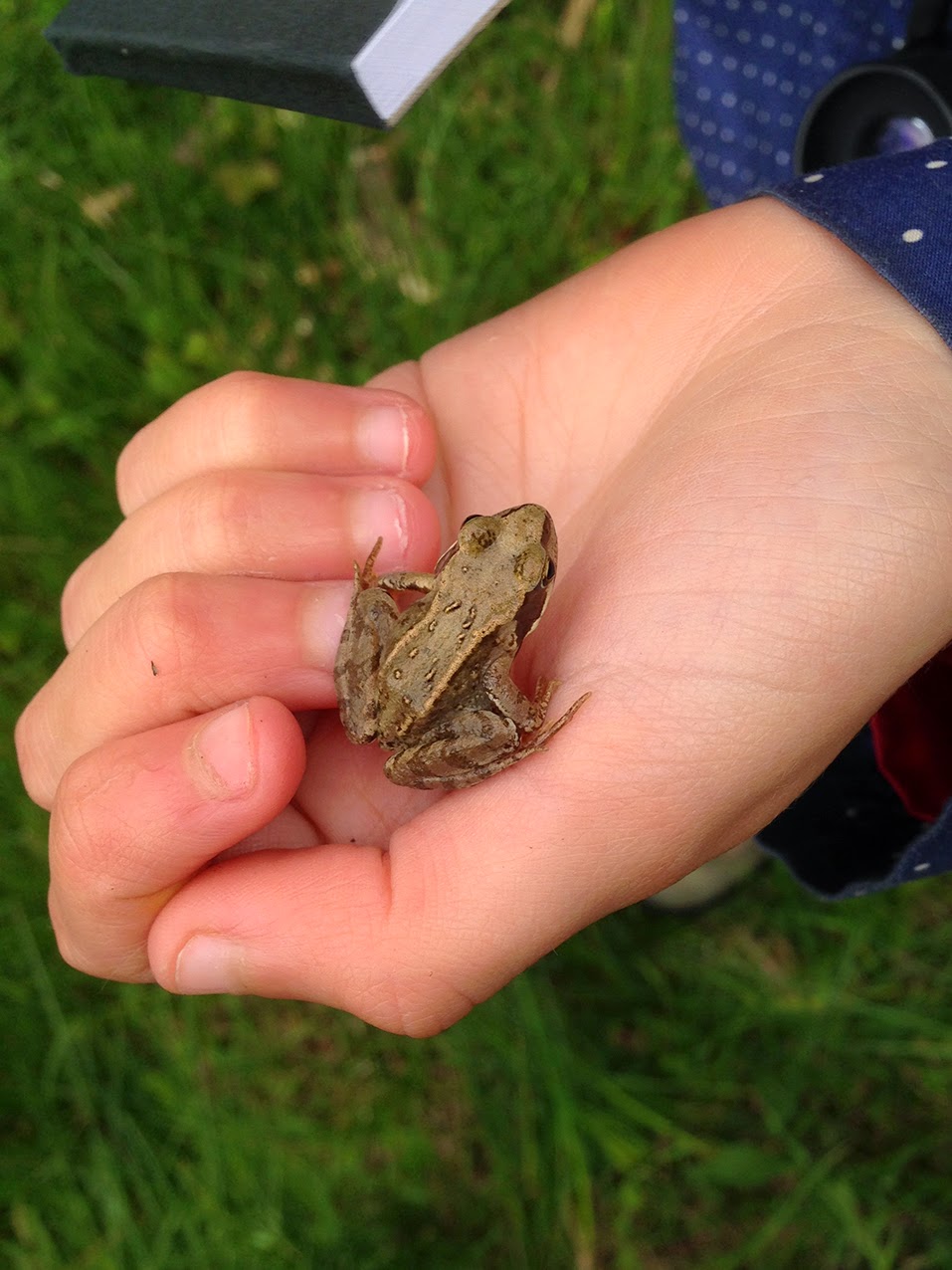
Shipley Glen is a steep-sided, wooded ravine (also called a clough), with a stream running into a small reservoir at the southern end. It has some rocky outcrops and is bordered by wildlflower meadows, grazing pasture and moorland. Different bird species like different habitats, so the area around Shipley Glen is a great place to see lots of bird species. It's also a good area for other types of animals and plants. One team found lots of young Common Frogs in the damp meadow, while we were listening for bird calls.

Common Frog, Shipley Glen - Sunday 17th May, 2015

Sunday, 26 April 2015

Wildlife Walk at St Ives, Bingley - Sunday 26th April 2015

We had a lovely wildlife walk around St Ives, Bingley, for our April event. We had everything we could ask for: bright sunshine, some nice wildlife moments and a really good turnout!

We met at 10:30 at the courtyard beside the St Ives visitor centre, as the newly-returned Swallows swooped over our heads. The stables at St Ives are a great place watch these fantastic birds nesting throughout the spring and summer.

Our route took us first up past the golf course, where the Swallows were zooming low over the grass in search of low-flying insects and a male Common Pheasant strutted his stuff. Chiffchaffs and Willow Warblers - migrant birds fresh in from Africa - were singing in the trees. These two species look almost identical to one another, and the best way to tell them apart is by their song. Willow Warblers do a lovely, happy, descending song; while Chiffchaffs repeatedly sing their name, "chiff-chaff-chiff-chaff".

You can find out more about these and all the other British birds on the RSPB website: http://www.rspb.org.uk/discoverandenjoynature/discoverandlearn/birdguide/.

We came to a field where a Little Owl is often seen on the wall, but it surprised us by being sat in a tree for once! It was quite far away so it wasn't easy to see - and they're called Little Owls because they are quite little!

Little Owl, St Ives, Bingley - Sunday 26th April, 2015

We moved on to the old barns, where we often see and hear Pippistrelle bats on our bat walks. This time we spotted a different kind of mammal: a Grey Squirrel, snoozing on a window ledge!

Grey Squirrel, St Ives, Bingley - Sunday 26th April, 2015

Around the top of the estate by Altar Lane some of us were very lucky to see a pair of Treecreepers building a nest! These small mouse-like birds often nest is little crevices in trees and under strips of bark. The birds were gathering grass, small twigs and moss to line their nest in gap in a tree trunk, occasionally making their very high-pitched calls. Meanwhile, the rest of the group were treated to two Blue Tits using an old tennis ball for nesting material!

We made our way past the heath and Lady Blantyre's Rock, near to where we have done Fungi Forays before, and down to Coppice Pond, passing more Chiffchaffs and Treecreepers on the way.

Mallards, Canada Geese, Coots and Moorhens were squabbling on the pond when we arrived. We rounded off the event with a quick look at the bird hide.

 Looking for the Little Owl, St Ives, Bingley - Sunday 26th April, 2015

Thank you to everyone who joined us a great walk in some fine weather! 


Thursday, 16 April 2015

Spring Wildlife Walk, Bingley - Sunday 22nd March 2015

We had a lovely walk along the River Aire on the morning of Sunday 22nd March, looking for evidence of Otters and signs of Spring.

Airedale Otters on the bridge over Harden Beck

The weather was perfect - warm and sunny and very Springlike. We met at Bingley Market Cross and followed the river downstream to Myrtle Park.

We soon spotted a pair of Grey Wagtails bobbing along the river. These relatives of the more familiar black-and-white Pied Wagtail are only partially grey. Their most obvious plumage colour is the bright yellow of their breasts.

It wasn't long before we found our first Otter spraint! Otters leave “spraints” – what we would call poo – on prominent rocks along the river, to mark out their territory.

Cameron, Airedale Otters leader, collects the Otter spraint

The first Otter spraint we found

The trees were full of birdsong - a clear sign the breeding season has started. We could smell the delicious Wild Garlic growing on the river bank, and further on we found Lesser Celandine - one of the first plants to flower in Spring.


Lesser Celandine, Myrtle Park, Bingley

In the sand and mud on the river bank we looked for animal tracks, hoping to see Otter prints. We found some prints; but these appeared to be from an American Mink. The Mink is smaller than the Otter, and the prints are therefore smaller. Like the Otter, American Mink breeds along the River Aire; but, unlike the Otter, which developed naturally on the UK, the wild Mink population exists because of escapes from Mink farms.

Minks tracks by the River Aire

We headed up into the woods, getting a great view over the park towards Bingley, and spotting a Goosander pair on the river.

Looking out over the river

We ended our walk with a visit to Harden Beck, before heading back along the river. Back in Bingley, we heard a Chiffchaff singing - it's a easy song to remember, because like the Cuckoo, it sings its name: "Chiffchaff, chiffchaff, chiffchaff"!

Thank you to everyone who joined us on the walk. See you next time!


Monday, 2 March 2015

Preparing our nestboxes for the new season

The Airedale Otters leaders recently visited Deep Cliff Wood in Harden to clean out the nestboxes ready for the 2015 breeding season. We placed 14 nestboxes in the private wood in January 2012 and have checked and cleaned them every year since then.

 Cleaning a nestbox - Deep Cliff Wood, Harden, February 2015

While we clean the nestboxes we also check to see if any have been used in the previous breeding season, and by which species. The results for the previous years can be found here: 2012 and 2013. The contents of the nestboxes this time will be from the 2014 breeding season.

Here’s a full list of what we found this year:

Box number
What we found
1
Bird poo!
2
Partially-built Great Tit nest.
3
Probable Nuthatch nest
4
Empty and clean
5
Bird poo!
6
Empty, though with some grass and poo
7
Empty and clean
8
Complete Blue Tit nest
9
Empty and clean
10
Partially-built nest
11
Empty and clean
12
Bird poo!
23
Complete Coal Tit nest
DJM
Complete Blue Tit nest 

The results are very similar to previous years, with at least three completed nests and two partially-built nests. Box 23 had our first Coal Tit nest. For the first time, we didn't find any unhatched/failed eggs.

The most interesting find was in box 3. The bottom of the box was filled with bark and soft, dry, rotten wood from a silver birch - up to a depth of 50mm (about 2"). The most likely candidate for this nest is the Nuthatch, which we have seen and heard plenty of in the surrounding woodland. Let's hope they come back and nest again this year.

 Nuthatch (photo Stephen Lilley)

We also found this discarded bottle full of moss in the wood. The moss, which would normally struggle to find sunlight under all the fallen leaves, had grown in the bottle - using it like a greenhouse.

 Moss growing in a milk bottle - Deep Cliff Wood, Harden, February 2015

Because the bottle was on top of the leaves, the moss could have as much sunlight as it needed; while the bottle created a moist micro-climate, just as the moss prefers. It's amazing what nature can do!

Friday, 16 January 2015

Big Garden Birdwatch 2015 at St Ives - Sunday 25th January

We once again took part in the RSPB's Big Garden Birdwatch for our first event of the year.

As in previous years, we met at the bird hide in St Ives (next to Coppice Pond) at 10:30 and spent an hour counting the birds visiting the feeders. The Airedale Otters leaders had placed food out for the birds before the event to ensure we would attract as many species as possible.

This year we recorded fewer bird species than on previous years -  this is probably because the weather was milder this year - but this year we had more individual birds.


Counting the birds is great fun, and can help you improve your bird identification skills. And on the Airedale Otters Big Garden Birdwatch we have the added attraction of hot chocolate and biscuits!

We will send the result of our survey off to the RSPB so they can add it to many others that will have been done up and down the country. You can see our results from the last two years here: 2014 and 2013. The RSPB's total results for all their previous surveys can be found here.

Thank you to everyone who came and help out with this year's count.

Monday, 17 November 2014

Olly the Otter is on Twitter!


Yes, Olly the Otter is now on Twitter!

Parents, you can now keep up with the latest info on Airedale Otters events and local wildlife news from Bradford and Airedale by following us on Twitter.

Just click on the link below to follow us, or click here to visit our Twitter page.